Controlled-environment agriculture — vertical farms, greenhouses, container farms, grow walls and grow towers — promises food all year, close to customers, with far less water and land. But it only pays when conditions are right every hour of every day. Famo Controlled Field is the Famo AI package built to do exactly that.
Five kinds of indoor farm, one platform
Famo treats every rack, bay, container, wall or tower as its own zone with its own recipe:
- Vertical farms — stacked, LED-lit racks for leafy greens, herbs and microgreens.
- Greenhouses — sunlight plus climate control for tomatoes, cucumbers, peppers, strawberries and flowers.
- Container farms — a complete, insulated farm inside a shipping container, placed near customers.
- Grow walls — living hydroponic walls for restaurants, shops, schools and offices.
- Grow towers — aeroponic towers that grow dozens of plants on a square metre of floor.
Start every crop on the right recipe
Indoor growing is about holding the right conditions. Famo tracks eight climate and nutrient targets per zone:
| Target | What it means |
|---|---|
| Day temperature | Air temperature during the light period |
| Humidity | Relative humidity of the air |
| VPD | Vapour pressure deficit — how strongly plants transpire |
| CO₂ | Carbon dioxide concentration for photosynthesis |
| PPFD | Light intensity reaching the canopy |
| DLI | Total light the crop receives per day |
| EC | Strength of the nutrient solution |
| pH | Acidity of the nutrient solution |
Famo ships with starting recipes for six crop groups — leafy greens, fruiting crops, herbs, flowers, microgreens and, for licensed growers where it is legal, cannabis — and tunes them per variety and growth stage.
How Famo runs a grow room
Famo Controlled Field works as a continuous loop:
- Sense — climate, light, CO₂, nutrient solution and cameras report every few minutes from every zone.
- Understand — Famo calculates VPD and DLI, links causes to effects and finds what is really holding a crop back.
- Decide — it compares each zone with its recipe and with the weather outside, and proposes the next setpoints.
- Act — the grower approves in one tap, or connected controllers, lights and dosing pumps adjust themselves.
- Learn — each harvest sharpens the recipe, the yield forecast and the harvest date for the next one.
Plant vision: see stress before it shows
Multispectral cameras measure how each plant reflects light that the eye cannot see. Famo compares each plant with its neighbours and with its own history, so a struggling plant stands out before its leaves change colour. Plant vision tracks every plant from transplant to harvest, flags early stress, tipburn and disease, and forecasts growth, yield and harvest date.
A day in a Famo grow room
- 5:00 — LEDs ramp up slowly to each zone's light recipe.
- 8:30 — Humidity climbs in one zone; Famo suggests a ventilation setpoint and the grower approves it in one tap.
- 11:00 — EC drops after a tank top-up; the dosing machine brings it back to recipe.
- 14:00 — A camera flags three lettuces with early tipburn, and Famo links it to low airflow on that tier.
- 18:00 — Famo forecasts the next harvest weight and lines up crates and staff.
Works with the equipment you already have
Famo reads standard sensors over RS485/Modbus and LoRaWAN, and connects to climate controllers, LED drivers and dosing systems over Modbus or MQTT. Growers add only the pieces they are missing. Growing systems, lights, sensors and controllers are available from the SmartSoil AI marketplace.
What is available today
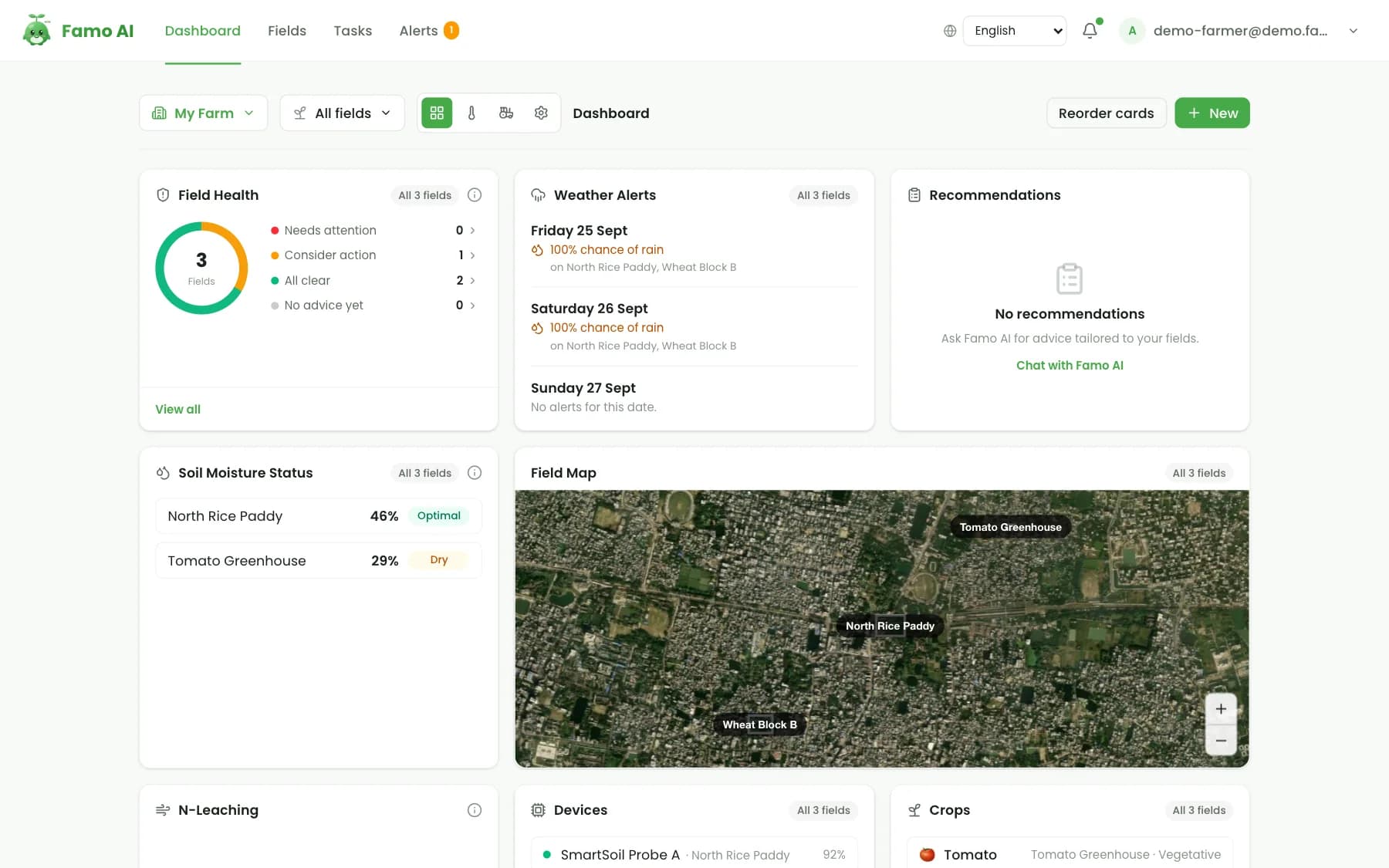
We are precise about this. The grow-room dashboard — live VPD and DLI against crop recipes, nutrient tracking and plant vision — is in the Famo dashboard today, and you can try it in the live indoor-farm demo. Climate control and robotics are being built together with our pilot farms and are marked "Coming soon". Famo Controlled Field is currently onboarding pilot farms, which get early access, direct contact with the product team and preferred hardware pricing in return for feedback.
The path to a smart grow room
| When | Step | What changes |
|---|---|---|
| Week 1 | Measure the room — climate, CO₂, PAR and nutrient sensors with the Famo grow advisor | VPD, DLI, EC and pH for every zone, live, with alerts when one drifts |
| Month 1 | Control the climate — climate controller, dosing machine, LED schedules | Every zone stays on recipe with far less hands-on work |
| Month 3 | See every plant — multispectral cameras, per-plant tracking | Stress is caught early and harvests are planned to the day |
| Year 1+ | Automate and scale — robots, solar and battery, more sites | One team runs more growing area from one dashboard |
Why it matters
Recirculating hydroponic systems can use up to 90% less water than open fields, produce 365 days a year whatever the season, grow food close to the people who eat it, and need no soil and far fewer pesticides. Famo's role is to make those advantages reliable, every hour, for every plant.
Frequently asked questions
Is Famo Controlled Field only for large commercial farms? No. The same platform runs a single container farm or grow wall as well as a multi-site greenhouse operation. You choose the systems and sensors for your size.
Can organic growers use it? Yes — for soil-grown polytunnels and greenhouses, see Famo Organic Farming, which adds organic records and certification tools.
How do I start? Design your package or join the pilot on the Famo Controlled Field page, or read how Famo AI works across all its packages.