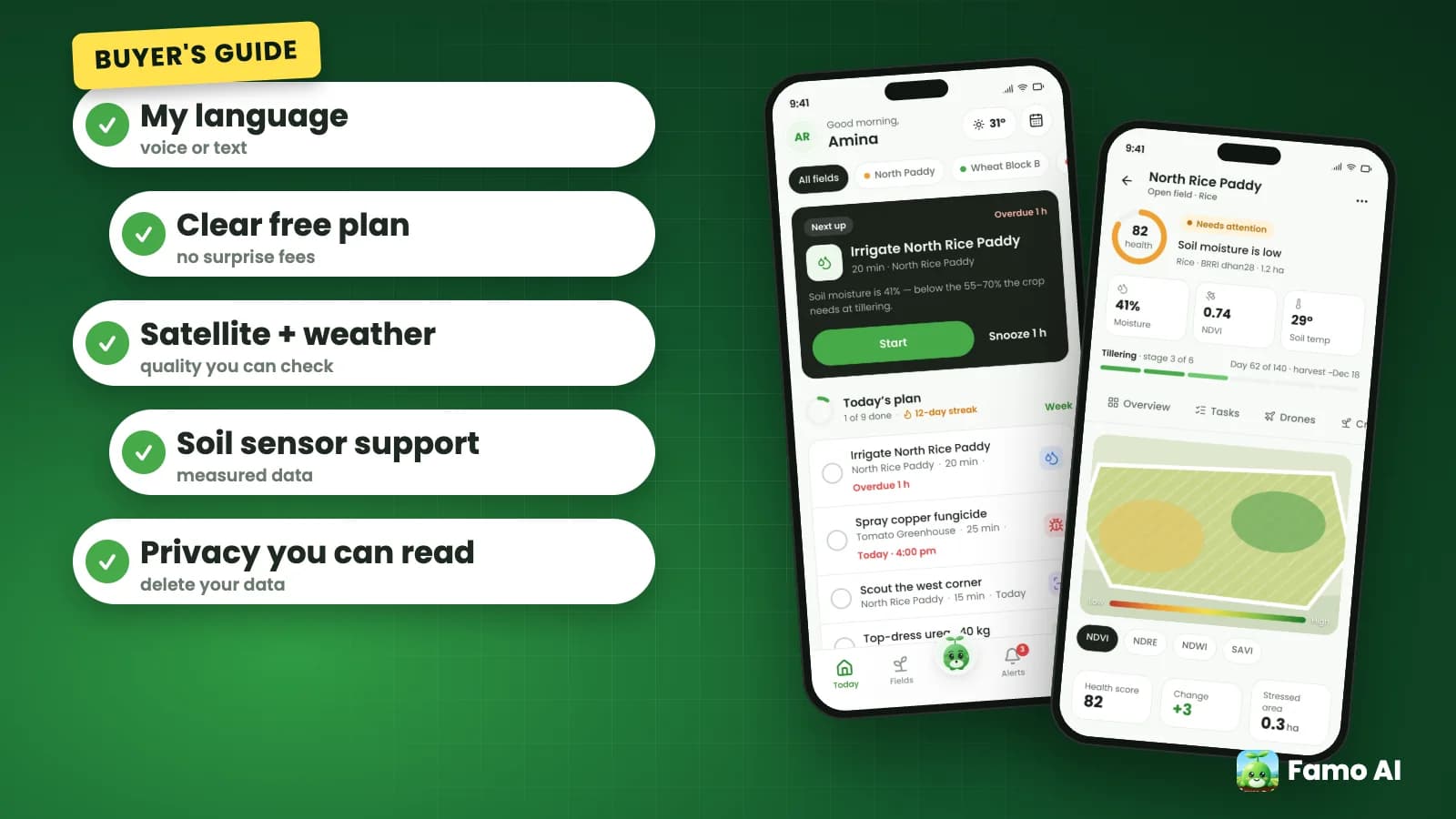
There are hundreds of farming apps, and the best one is the one that fits your farm, language and budget. Use this checklist before you spend time or money. It works for any app, including ours.
In short
- Check the language first. If you cannot use it comfortably, nothing else matters.
- Know exactly what is free and what you pay for.
- Look for proof: recent updates, real reviews, and clear privacy information.
- Match the tools to your problem: crop health, soil, water, disease or records.
The 10-point checklist
| # | Ask this | Why it matters |
|---|---|---|
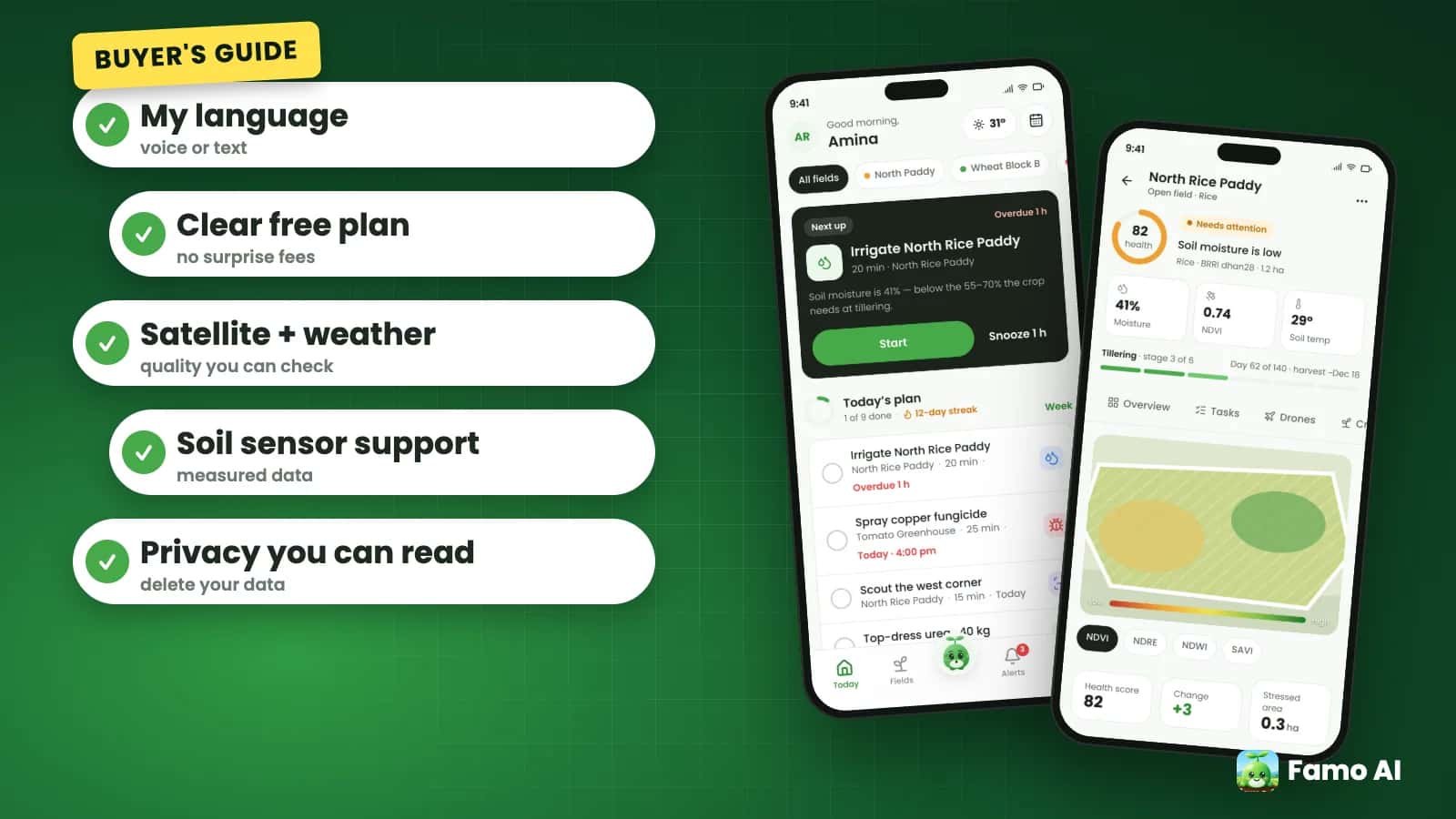
| 1 | Does it work in my language, by voice or text? | You act on advice you understand. |
| 2 | Does it suit my farm size and crops? | Some tools target very large farms or one region. |
| 3 | What is free, and what costs money? | Look for a clear free plan and per-field pricing, not surprise fees. |
| 4 | How easy is it to add my field? | Drawing a boundary should take minutes. |
| 5 | How good are the satellite and weather data? | Free satellites show about 10 metre detail every few days; clouds can delay images. |
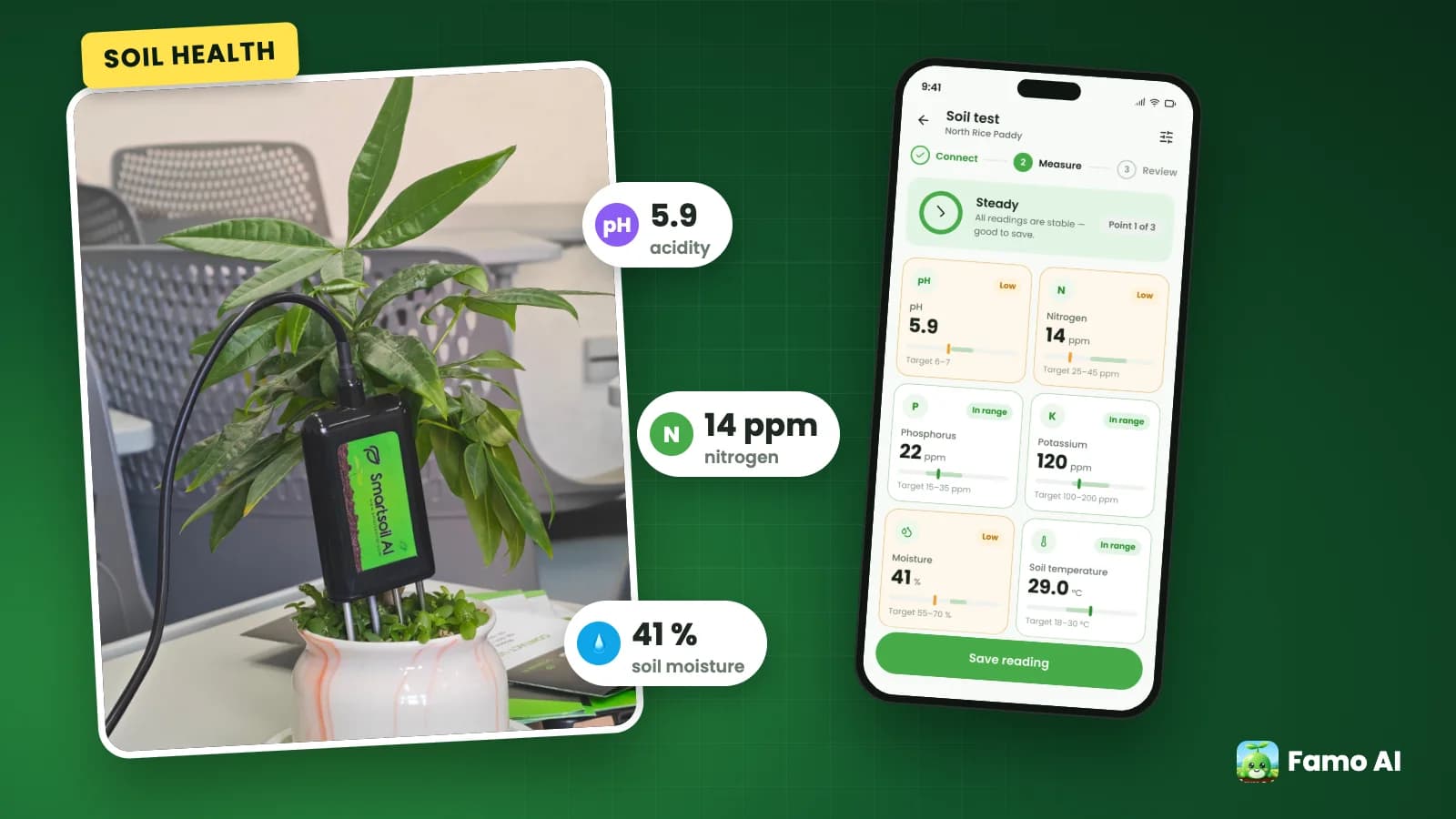
| 6 | Can it use ground data, like a soil sensor? | Measured soil data makes advice far more specific. |
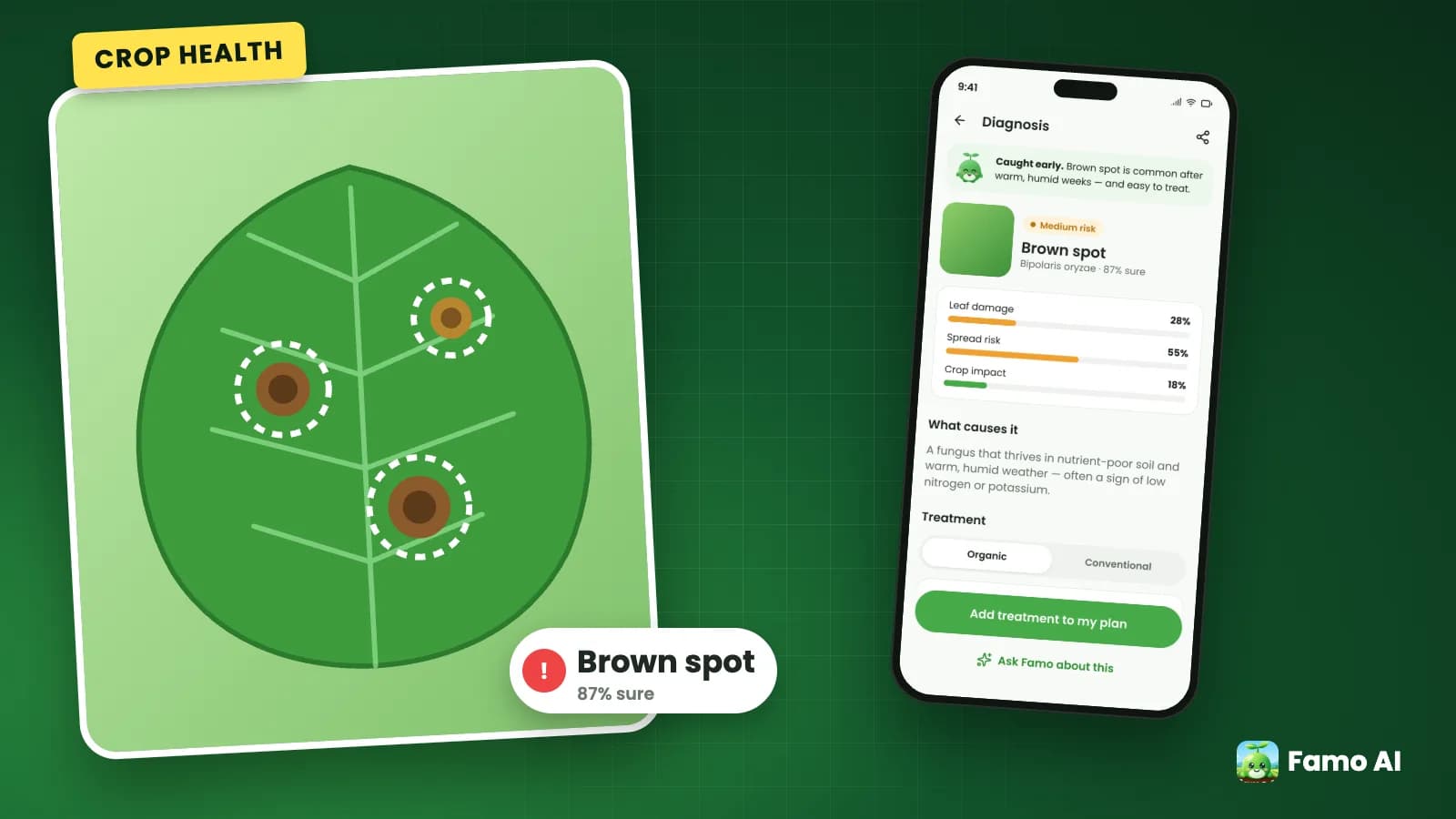
| 7 | Can it help with disease and pests? | Early scanning of leaves saves crops. |
| 8 | Does it keep records I can export? | Records help with planning, loans and certification. |
| 9 | Is it actively supported? | Check the last update date, reviews and whether the developer answers. |
| 10 | Is my data protected? | Read the privacy and data-safety information, and check you can delete your data. |
Red flags
- Guaranteed yield or income. No app can promise that.
- No privacy details, or an unclear explanation of what data is shared.
- No way to try before you pay.
- Old updates and unanswered reviews.
- Pressure to buy equipment you do not need.
Free versus paid: what is reasonable?
Basic field mapping, satellite crop checks and weather are widely offered free. Paying usually unlocks deeper history, extra analysis, team features or prescription maps. Choose a paid plan only after the free version has solved a real problem for you.
Try before you decide
Test any app on one field for a full week:
- Add your field and see how long it takes.
- Open the crop-health map and ask whether it matches what you see on the ground.
- Ask a real question in your language.
- Check how the app handles weak signal.
Where Famo AI fits, honestly
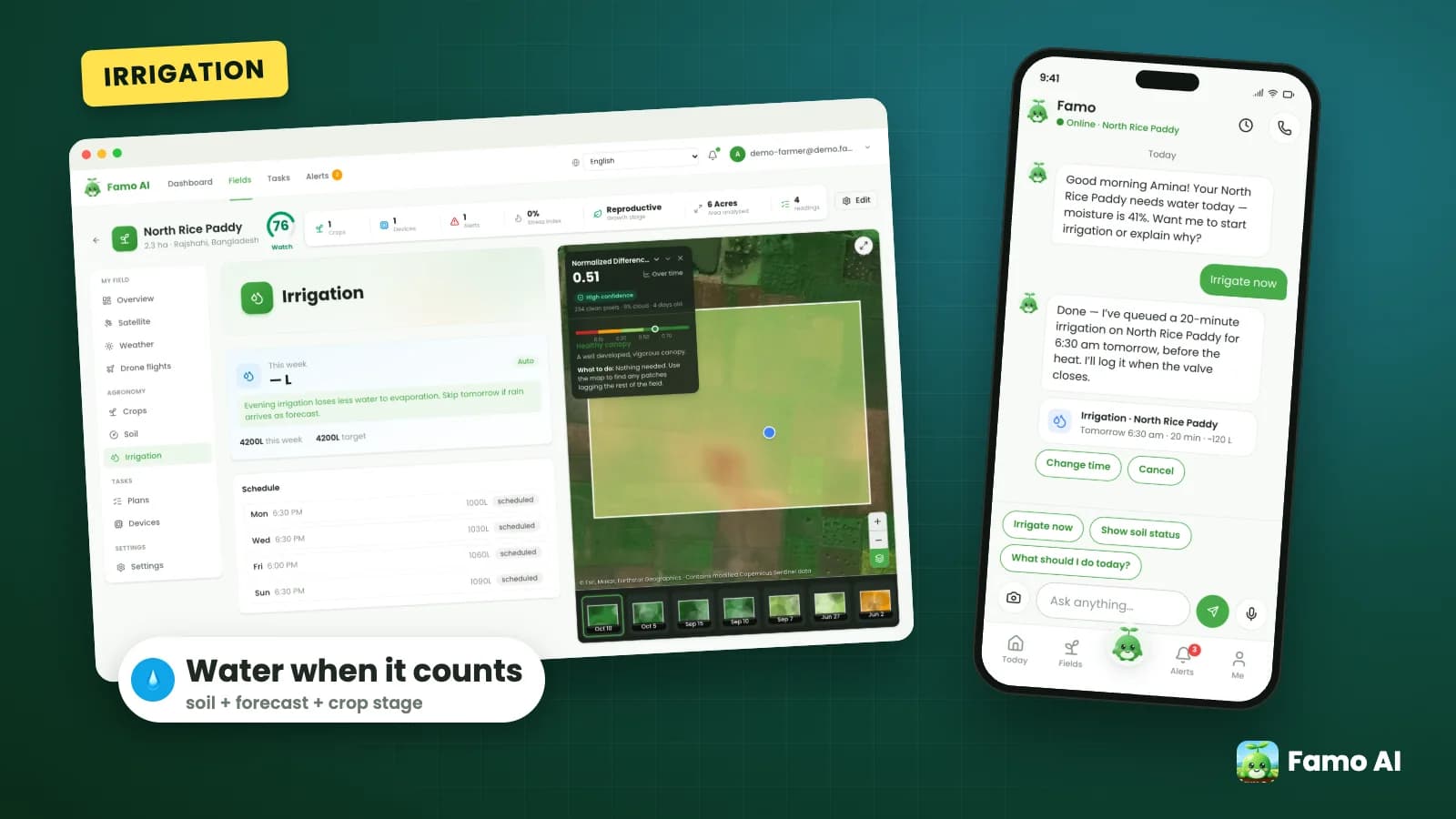
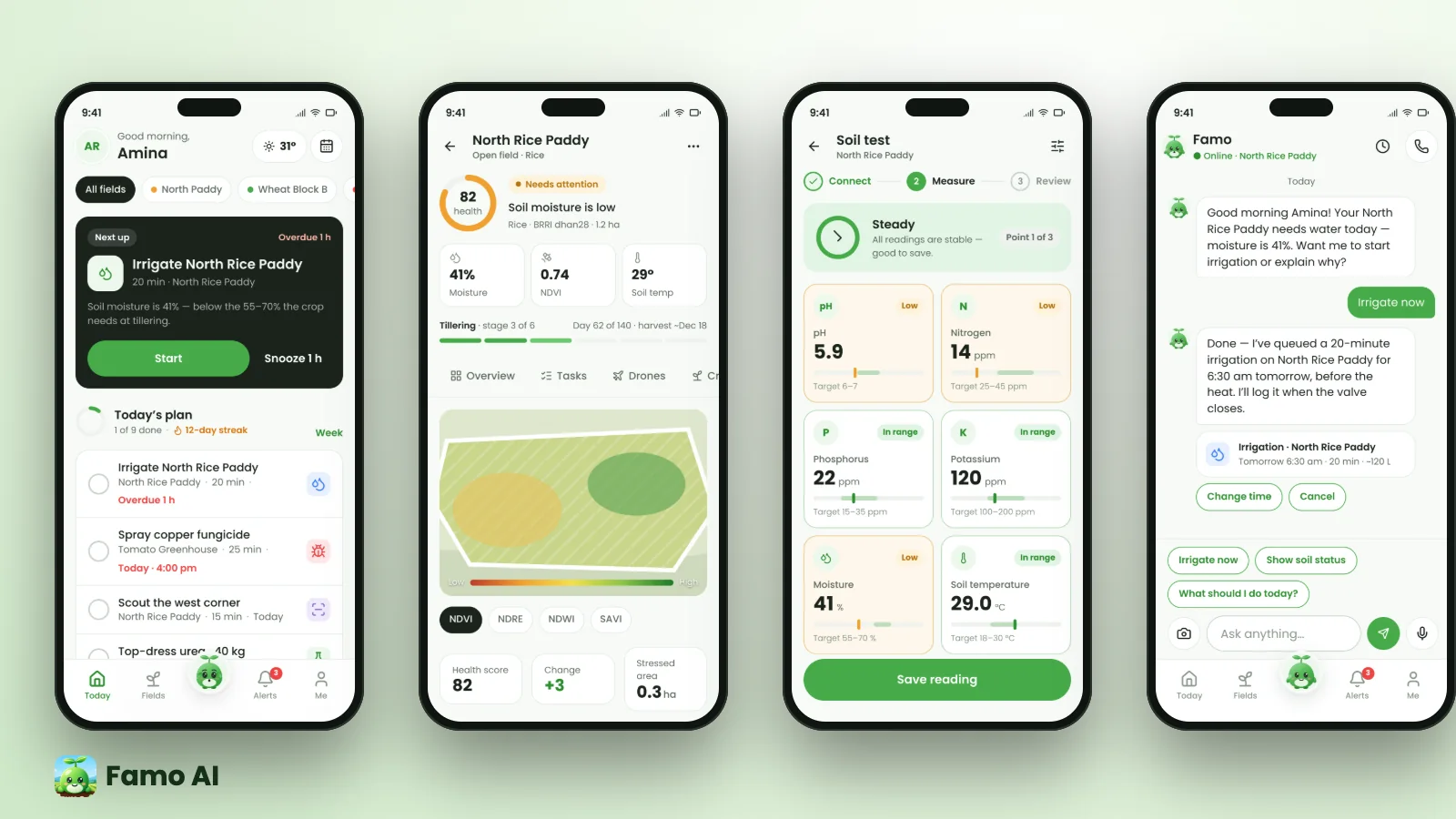
Famo AI is built for farmers who want advice in their own language and who may have small or medium fields. It combines satellite monitoring, a soil sensor, weather, leaf scans, tasks and a voice advisor in 12 languages, with a free Starter plan and per-field pricing for the rest. It also has dashboards for cooperatives, greenhouses and organic farms.
It has limits too. Most live features, such as satellite maps and leaf scans, need an internet connection, though recent fields and tasks stay readable offline. Satellite detail is about 10 metres, so tiny plots show less. And AI advice is a first check, not a replacement for your local extension officer.
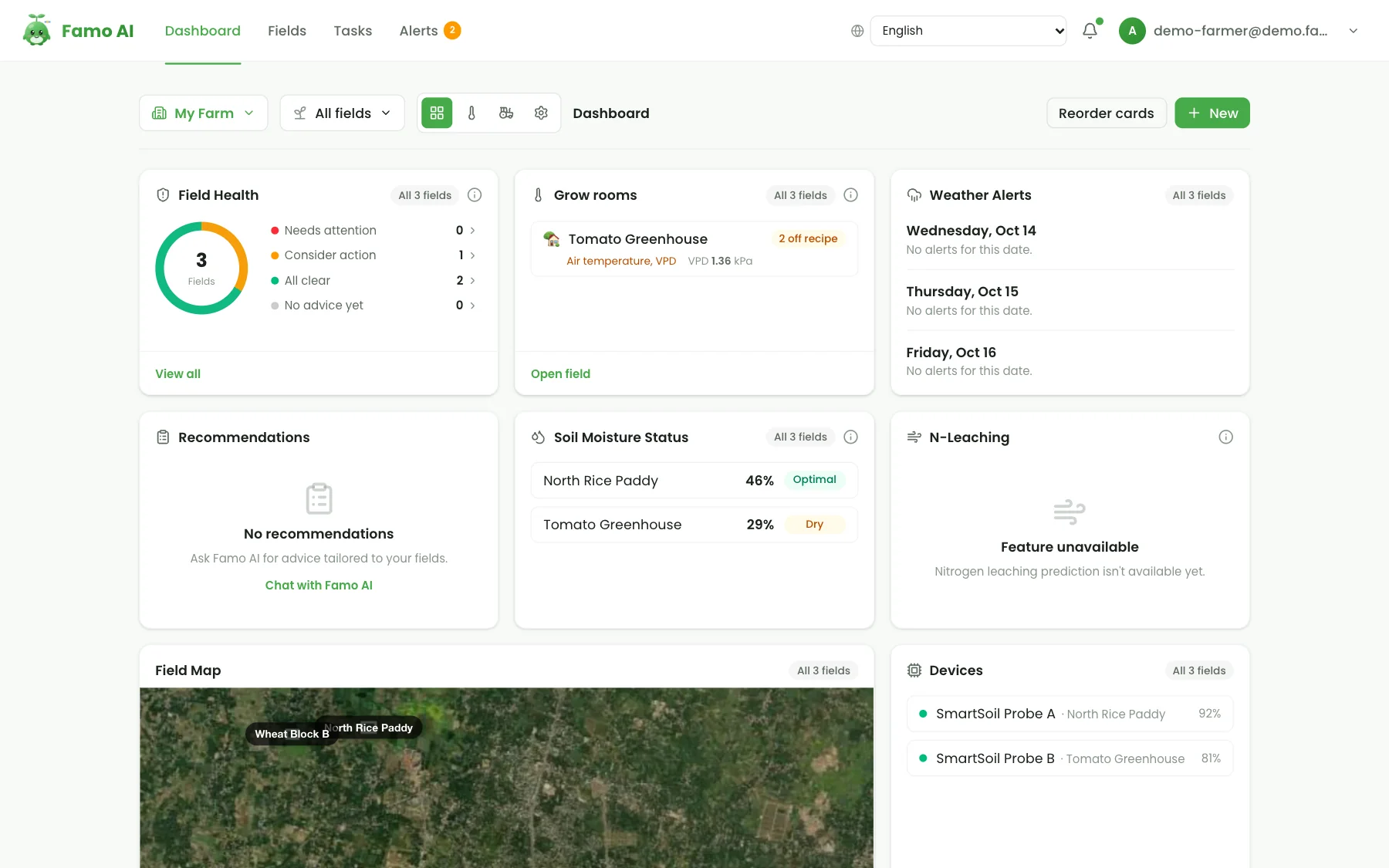
Get Famo AI on Google Play or try the live demo, no sign-up. See how Famo AI works.
Frequently asked questions
What is the best free farming app?
It depends on your crop, region and language. Use the checklist above and test two or three on the same field before you decide.
Do farming apps work without internet?
Some features do and some do not. Look for an app that keeps recent fields and tasks available offline, and be aware that satellite maps and AI scans usually need a connection.
Is my farm data safe in a farming app?
Check the privacy policy and the store's data-safety section, make sure you can delete your data, and avoid apps that do not explain what they share.
Do I need a soil sensor?
Not to start. A sensor adds measured soil data, so consider it when you want precise fertiliser and irrigation decisions.