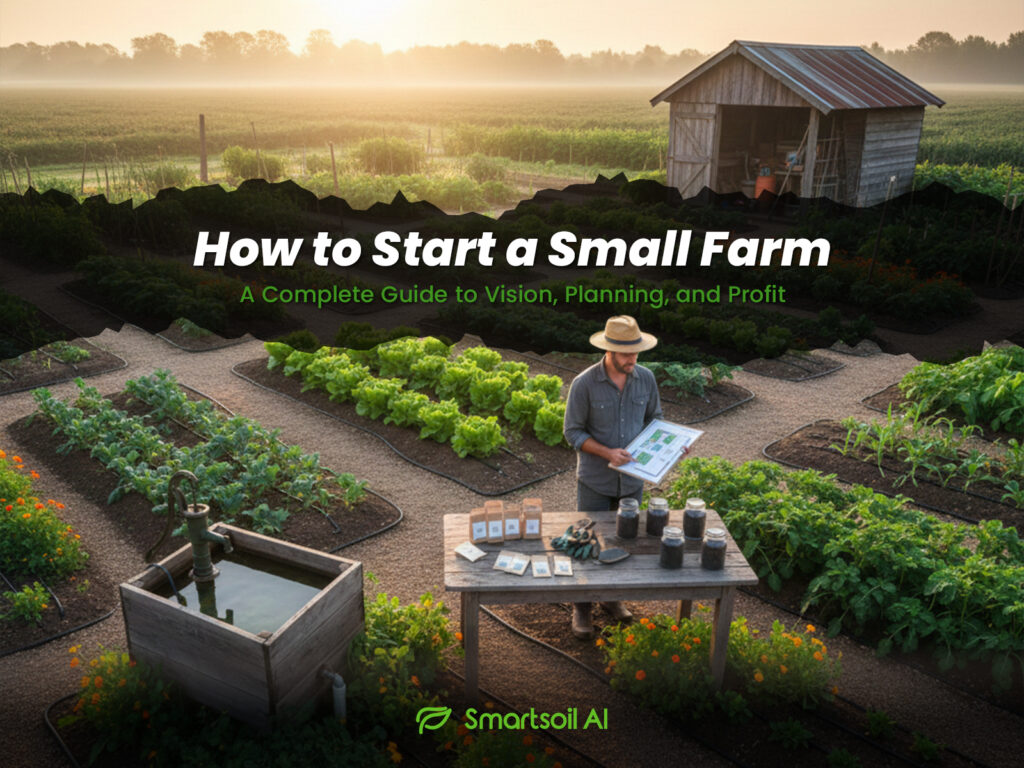
Starting a small organic farm is not just about moving to the countryside and being your own boss; it’s an entrepreneurship adventure that requires careful planning, strategy, and business management. Contrary to common belief, you don’t need a huge investment, millions of dollars in land, or heavy machinery to be successful. A much smarter approach is to focus on intensive, small-scale methods and avoid going into debt.
Here is a complete guide to starting your successful small farm.
1. The Foundation: Vision, Mission, and the Business Plan
Any major project, especially a farm, must begin with a clear, detailed vision that acts as your roadmap.
- Detail Your Dream: Be specific about where you want to be in five years. What will you grow—vegetables, animals, or both? How many people will work on the farm? What kind of income are you aiming to generate? Dream big, but ensure that dream is written down.
- Develop a Business Plan: A financial roadmap is the cornerstone of your success. This common-sense plan must track all projected expenses (land acquisition, infrastructure, tools) and forecast cash flow over five years. This planning is essential, especially if you need to borrow money, as it proves how the investment will pay off.
- Define Your “Why”: Understand your core motivation. For many successful farmers, this “why” involves a mix of personal goals (raising a family in the country, working outdoors) and ecological values (service to the community, responsible growing). Writing down a mission statement fueled by positive expressions will sustain your commitment through inevitable hardships. Revisit your “why” regularly to stay energized.
2. Gain Essential Knowledge and Experience
Farming is a hands-on skill set that demands dedicated learning and practical experience.
- Immerse Yourself in Learning: Read books from industry masters, take courses, and visit many different farms to talk to growers. Invest your time in learning everything from dealing with insects and disease to managing soil fertility and handling market sales.
- Work on a Farm for One Full Year: This is the most mandatory step for aspiring farmers. Commit to a full season—from day one to the last day—to ensure you are truly cut out for the job. This real-world experience observing patterns and methods will significantly shorten your learning curve.
3. Start Small and Manage Smartly
A common mistake is oversimplifying the management required for a piece of land. The key to profitability is intensive management on a small scale.
- Focus on Intensity, Not Acreage: The small-scale farming model suggests that even 1–2 intensively managed acres is a lot of work, often requiring a team of several people. Do not start with 5–10 acres. The philosophy is to “do less, do better.”
- Maximize Yields: Success is measured by yield per square meter, not by the size of the farm. High profitability is achieved through intensive techniques like succession cropping (quickly flipping one crop for another), growing multiple crops per bed, and using season extension (caterpillar tunnels, row covers) to be the first to market.
4. Choose Land and Design with Purpose
The quality and layout of your farm land will impact your efficiency and profitability for years to come.
- Land Selection: Soil: Prioritize prime acres with excellent soil quality, ideally a mix of loam and sand, good depth, and proper topography to ensure water drains well. Water: Access to water is non-negotiable for both irrigation and the washing/cleaning of vegetables. Market Proximity: Ensure you are close to a market that is in demand for local, organic produce, as farming is a business requiring a willing customer base.
- Farm Design: Your farm must be cleverly designed to connect all elements for maximum efficiency. For example, a central location for the wash-pack area and tool shed minimizes foot traffic and lost time traveling to and from the fields. Standardize the length and width of your beds to ensure tool efficiency and design a proper flow for post-harvest handling.
5. Equip Yourself with Appropriate Technology
Having the right equipment for the right scale is vital.
- Appropriate Technology: The common mistake for direct-market farms is relying on heavy machinery (tractors) designed for high-volume wholesaling.
- Hand Tools and Systems: For small-scale, diversified market gardening, highly specialized hand tools and systems are more appropriate than a tractor, especially when adopting a permanent bed strategy that doesn’t rely on plowing. The right set of tools increases effectiveness and efficiency.
6. Crop Planning and Post-Harvesting Mastery
These two systems are crucial for ensuring high-quality produce and consistent supply.
- Crop Planning: The art of figuring out what to plant, where, and how involves orchestrating complex crop successions and rotations. Beginners should focus on mastering 5 to 15 key crops initially, clearly planning what will be planted, when, and what it will be replaced with.
- Post-Harvest Handling: A significant part of the job is harvesting, washing, cleaning, packing, storing, and delivering the produce. True “freshness” means the vegetables were harvested, immediately cooled (to stop respiration), and delivered cold within 24 hours. You must invest in proper infrastructure, including a cold room and a well-designed wash-pack station, to ensure your vegetables look incredibly fresh.
7. Selling is Half the Workload
You are running a business, and marketing your product is just as important as growing it.
- Diversify Sales Channels: Relying on a single market is risky. Utilize a mix of opportunities, such as farmers’ markets, Community Supported Agriculture (CSA), restaurant sales, and semi-wholesale to local grocery stores. Having multiple channels provides stability if one market experiences a slowdown.
- Efficient Scheduling: Optimize your labor by aiming for a maximum of two harvest days per week to supply all your sales channels.
8. Focus on the Most Profitable Crops
Concentrate your energy and attention on the crops that will bring the “biggest bang for the buck.”
- High-Value Crops: Focus on crops that command a higher price when sold directly: Root crops sold with their green tops (carrots, beets, radishes) dramatically increase value. Fresh-cut lettuce and greens, harvested twice a week for maximum quality. Greenhouse crops (tomatoes, peppers, eggplant) which, when brought to market early, sell at a premium before field production begins.
Final Advice: Commit to Learning and Community
Farming is a journey of continuous learning. Commitment to this process is key, as is connecting with a community of like-minded farmers who can share your dreams and hardships. If the idea of farming is calling you, follow that dream. The world needs people committed to local food, community, and ecology—it is entirely worthwhile.
Video source: How To Start A Small Farm | Complete Guide