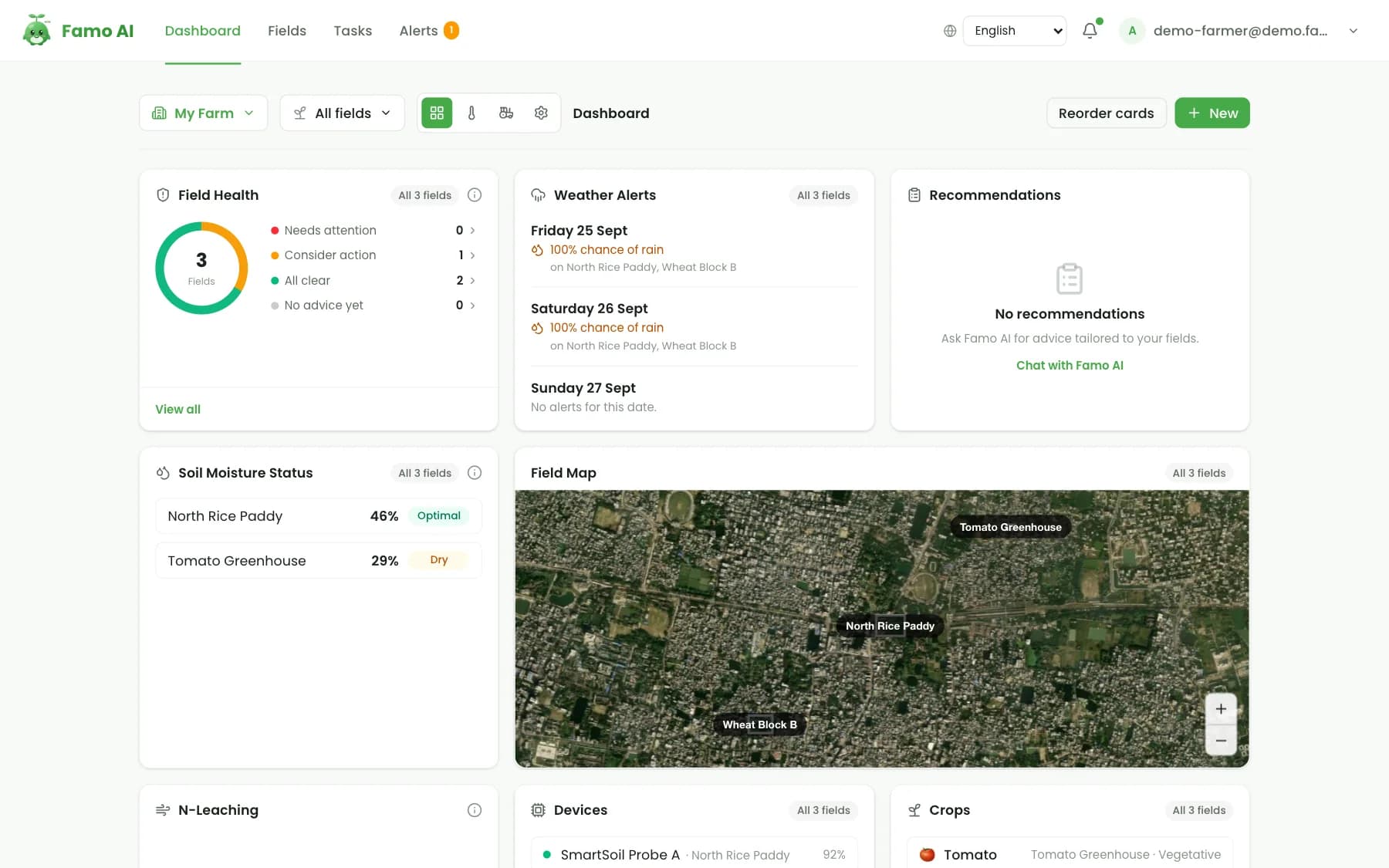
Field crops — rice, wheat, maize, cotton, sugarcane, potatoes, vegetables — feed most of the world, and they are grown under the open sky, exposed to every change in weather, water and pests. Famo Open Field is the Famo AI package built for these farms. It brings satellites, drones, soil sensors, weather stations and smart irrigation together, and lets Famo turn all of it into one clear plan for the day.
Five layers of farm data, one brain
Each kind of data sees something the others cannot. Famo Open Field organises them into five layers:
- Space. Sentinel-2 optical and Sentinel-1 radar imagery over every field, with more than 30 indices — NDVI, NDRE, NDWI and others — refreshed every 3–5 days. Radar sees through cloud.
- Air. Multispectral and spray drones zoom in where satellites see a problem: centimetre-level maps, plant counts and variable-rate spraying.
- Field. Soil probes, weather stations, leaf-wetness sensors and AI pest traps report around the clock: moisture and NPK, microclimate, pest counts.
- Water. Drip lines, pivots, fertigation and solar pumps deliver what the crop needs and no more, on a smart schedule.
- Machines. RTK guidance, field robots, cameras and solar power keep the work precise and running off-grid.
Every layer lands in the same Famo dashboard and app, so there are no extra logins and no spreadsheets.
Closed loops, not just charts
Data matters only when it changes what happens in the field. Famo Open Field is designed around three closed loops:
Water. Soil probes see moisture falling → Famo checks the forecast rain and the crop stage → irrigation is scheduled for the right block → water use is logged per field.
Nutrients. A soil test and an NDRE map show a gap → Famo writes the fertiliser plan → fertigation or a drone applies it by zone → the next satellite scan checks the result.
Protection. Leaf wetness and humidity stay high → trap cameras count rising pests → Famo raises a disease and pest alert → a drone sprays only the hot spots.
A day on a digital farm
Here is what an ordinary day can look like with Famo Open Field:
- 6:00 — Famo reads out today's plan in the farmer's language: two fields to irrigate, one to scout.
- 9:30 — Soil nodes in one block fall below target, and the controller opens its valves for the right time.
- 12:00 — Wind is rising in the afternoon, so Famo moves tomorrow's spraying to the early-morning window.
- 15:00 — Satellite NDRE shows a pale patch; a drone flight confirms nitrogen stress and a prescription is ready.
- 19:00 — Trap cameras log a rise in moths overnight, and Famo raises an alert with a suggested check.
You don't have to change everything at once
Most farms move to a digital farm in four steps, each paying for the next:
| When | Step | What is added | What changes |
|---|---|---|---|
| Week 1 | See your farm | Famo app and dashboard, fields on the map, satellite and weather monitoring, one soil test per field | Every morning you know which field needs you, and why |
| Month 1 | Measure it live | Soil sensor network, on-farm weather station, LoRaWAN gateway, AI pest traps | Irrigation, spraying and fertilising follow real numbers |
| Season 1 | Automate water and nutrients | Smart irrigation controllers, fertigation dosing, remote and solar pumps | Water and fertiliser go where each zone needs them |
| Year 1+ | Precision at scale | Multispectral and spray drones, RTK guidance, field robots | Plant-level decisions across the whole farm |
Built for weak connectivity
Many field farms have poor mobile coverage. In Famo Open Field, sensors talk to a LoRaWAN gateway over long-range radio, and the gateway needs only a single 4G or Wi-Fi connection for the whole farm. The Famo app keeps working offline and syncs when it can.
Choosing your package
On the Famo Open Field page you can switch modules on or off and set your farm size; the kit and an estimate update instantly using real products from the SmartSoil AI marketplace. A sizing guide explains how many of each device a farm needs and why. Our team then confirms the kit with you and handles assessment, installation, training in your language and ongoing support.
Two things are worth knowing:
- You only buy what you need. Many farms start with satellite monitoring, soil testing and a few soil nodes, then add drones or irrigation control later.
- We are clear about what is ready today. All hardware in the builder is available now. Deeper integrations — such as processing your own drone flights inside the dashboard — are marked "Coming soon" until they ship.
How Famo Open Field is priced
The Famo software is priced per field, per crop season, with a free starting plan. Hardware is quoted separately, including delivery and installation, once your kit is confirmed.
Frequently asked questions
Which crops is Famo Open Field for? Any crop grown in open fields — cereals such as rice, wheat and maize, cash crops such as cotton and sugarcane, potatoes, pulses and vegetables, and orchards.
Do I need drones to use it? No. Drones are an optional layer. Satellite monitoring, soil sensing and weather already give Famo enough to plan irrigation, fertiliser and scouting.
Can I see the dashboard before buying? Yes. The live farmer demo shows a sample farm with satellite history, soil readings, irrigation, tasks and alerts — read-only and without sign-up.
Ready to see your farm from orbit to root? Build your Famo Open Field package, or start with the free Famo AI app.