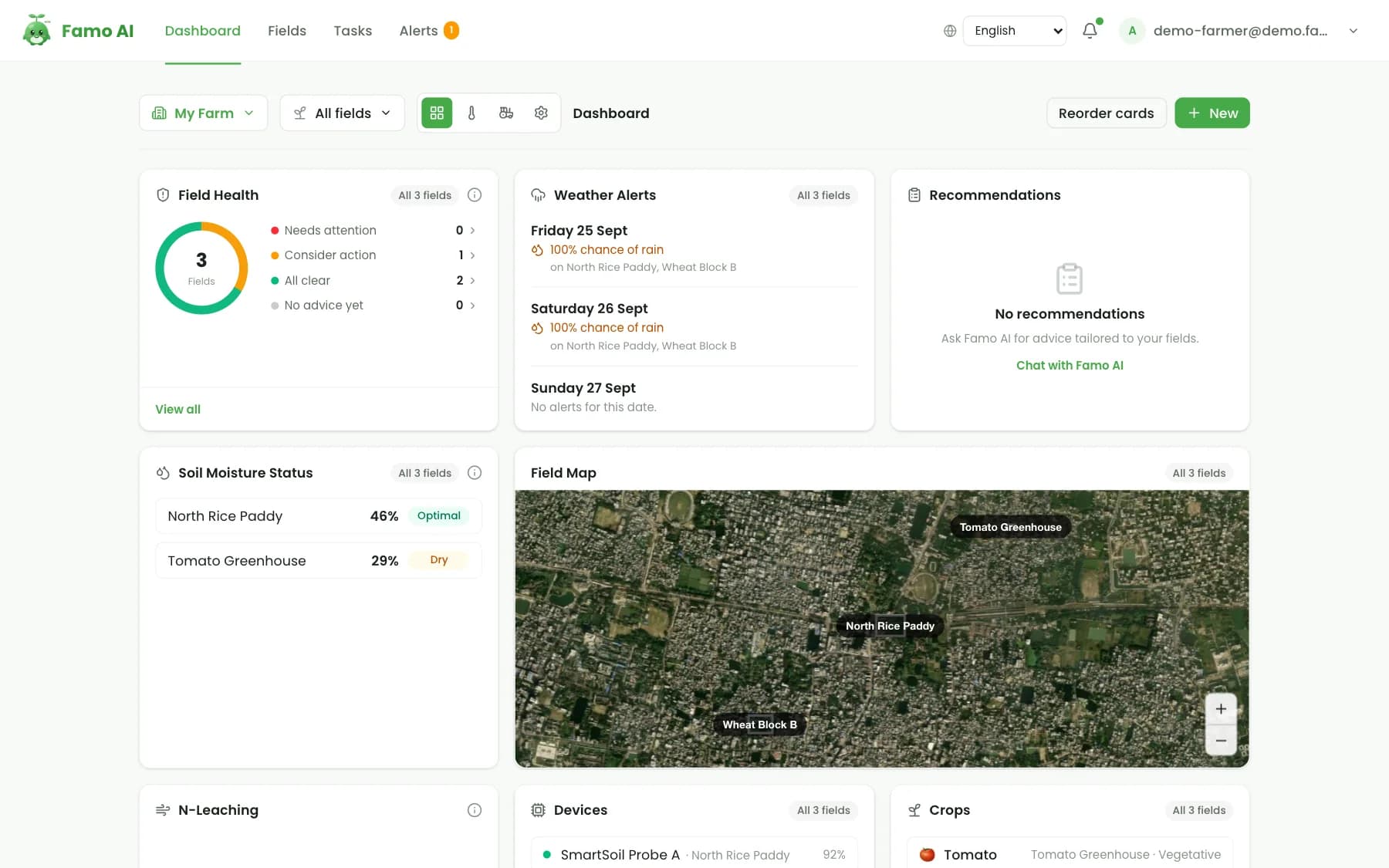
Fertiliser is one of the biggest costs on any farm, and much of it is wasted: applied by habit, in the wrong amount, at the wrong time. The reason is simple — most farmers never see a soil test. Laboratory tests are slow, expensive and far away. SmartSoil AI's answer is a handheld sensor that reads the soil in seconds and Famo AI, which turns the reading into a plan.
What the sensor measures
The SmartSoil 8-in-1 sensor is pushed into the soil and reads, in under a second:
| Reading | Why it matters |
|---|---|
| pH | Controls which nutrients the plant can take up; most crops prefer slightly acidic to neutral soil |
| Nitrogen (N) | Drives leaf and stem growth |
| Phosphorus (P) | Roots, flowering and grain or fruit set |
| Potassium (K) | Water regulation, disease resistance, fruit and grain quality |
| Moisture | Whether the crop has water available now |
| Salinity (EC) | Salt build-up that stunts growth — common in irrigated and coastal land |
| Temperature | Seed germination, root activity and nutrient release |
Against a government soil-laboratory benchmark, the sensor's readings were 95% accurate, at about $10 per test instead of about $50 at a lab — and with the answer in the field, not weeks later.
How to take a good reading
A sensor is only as good as the way it is used. Famo guides each test step by step:
- Test several spots. Soil varies across a field. Take three or four readings in a zigzag across the field rather than one in a corner — Famo averages them.
- Use the same depth. Push the probe to the root zone (around 15 cm for most crops) and record the depth. Readings from different depths cannot be compared.
- Let it settle. The first values a probe gives are the least accurate. Hold it still for a few seconds; Famo shows when the reading is steady and safe to save.
- Make good contact. In loose or very dry soil, firm the soil around the probe; if values keep jumping, push it in further and try again.
- Test at the right time. Before sowing for the basal plan, and again at key growth stages for top-dressing.
The sensor connects to the phone, and readings save directly to the field in the Famo app.
From numbers to a fertiliser plan
A list of numbers does not tell a farmer what to buy. Famo does:
- It compares each reading with the targets for that crop and stage — so pH 5.9 is "in range" for one crop and "too acidic" for another.
- It writes a fertiliser plan with the product, dose, timing and method, split across the season where that makes sense, with organic alternatives.
- It flags problems that fertiliser will not fix, such as high salinity or very low pH, and suggests amendments like lime or gypsum.
- It tracks every reading over time, so the farmer can see whether nutrient levels and pH are moving the right way.
Without any soil reading, Famo still gives general recommendations — but it marks them as general, and suggests a test for precise doses.
The payoff
Getting fertiliser right saves money and protects the soil. SmartSoil AI's work with farmers points to savings of up to a quarter of fertiliser costs, alongside better yields, when application follows a test rather than habit. Every farm is different, which is exactly why the test matters.
Live soil sensors for larger farms
For farms that want continuous data rather than spot checks, Famo Open Field adds a network of in-ground soil probes that report moisture and nutrients around the clock through a long-range gateway, feeding automatic irrigation and fertigation.
Get started
The sensor is available from SmartSoil AI — see the product page or contact the team. The Famo AI app is free to start on Google Play. And you do not need the sensor on day one: Famo's satellite monitoring, tasks and AI advisor work without it — see how Famo AI works.