Demand for organic food keeps growing — from shoppers, supermarkets and exporters — and farms that build their soil cope better with drought and heavy rain. What holds most farms back is not the farming itself but the know-how, the timing and the records that certification requires. Famo Organic Farming is the Famo AI package designed for exactly that.
Why farms go organic
- Better prices. Certified organic produce usually sells at a premium, at home and for export.
- Lower input bills. Compost, green manure and biological controls made or multiplied on the farm replace bought chemicals.
- Living soil. More organic matter holds more water and nutrients, and the soil becomes easier to farm each season.
- Climate resilience. Soils rich in organic matter ride out dry spells and soak up storms.
- Market access. A certificate and clean records open doors to exporters and premium buyers.
The hard parts of organic farming — and how Famo handles them
Feeding the crop without synthetic nitrogen. Soil sensors and soil-health tests show what the crop is short of. Famo plans compost, green manure and biofertilisers by crop stage and times them to the soil's warmth and moisture.
Pests and disease without synthetic sprays. Leaf-wetness and weather data flag disease weather before it strikes, and trap and camera counts show when a pest is building — so Bt, neem or released beneficial insects go on while they still work.
Weeds without herbicides. Famo reads soil moisture and the forecast to pick the days when weeds are small and the soil is right for a mechanical pass or mulch.
Compost that is safe and certifiable. A wireless thermometer in each windrow proves the 55 °C heat phase. Famo counts the hot days and turns against your standard and tells you when to turn.
The paperwork. One record book per field: every input is checked as it is logged, raw-manure intervals and certificate dates are watched, and the inspector gets a clean download.
The conversion years. A countdown to the first organic harvest under your standard, with soil-health and yield trends that show the transition is working.
Every input checked as you log it
When a farmer logs an input, Famo checks it against the broad rules most organic standards share:
| Status | Examples |
|---|---|
| Allowed | Compost and composted manure, green manure, biofertilisers such as Rhizobium and mycorrhiza, biological controls such as Bt and Trichoderma, neem, rock phosphate, gypsum, lime, traps and insect nets |
| Restricted | Copper fungicides (capped per hectare), raw manure (minimum interval before harvest), sulphur, pyrethrin and spinosad, micronutrients when a test shows a deficiency |
| Prohibited | Synthetic fertilisers such as urea, DAP and MOP, synthetic herbicides, insecticides and fungicides, sewage sludge, GMO and chemically treated seed |
If Famo cannot tell from the product name, it asks the farmer to check the label. Rules differ by standard and country, so Famo's check is an early warning — the certification body always has the final word.
The standards Famo tracks
Each field can be set to its own standard, and Famo applies that standard's conversion period, raw-manure interval and compost rule to the records:
- USDA Organic (NOP) — for the United States and exports to it.
- EU Organic (Regulation 2018/848) — for the European Union and exports to it.
- India Organic (NPOP) — for India and exports under NPOP.
- Japan Organic (JAS) — for Japan and exports to it.
- Participatory Guarantee Systems (PGS) — for smallholder groups and local markets.
From conventional to certified, year by year
Most standards ask for two to three years of organic management before a harvest can be sold as organic. Famo makes each of those years count:
- Month 0 — Baseline and plan. A soil-health test of every field, an organic record book from day one, buffer zones and a rotation plan.
- Year 1 — Build the soil. A compost yard with thermometers, green manure and cover crops, soil sensors and a weather station.
- Year 2 — Protect the natural way. Pheromone and light traps, biological controls on time, mechanical weeding windows.
- Year 3 — Certified and selling. Inspection-ready records, certificate tracking and traceable harvest lots.
Organic and conventional fields in one account
Many farms convert field by field. In Famo, the farming mode is chosen per field when it is added — open field, greenhouse or another growing environment. Organic fields get the record book and certification tools; all fields share one dashboard.
What Famo does — and does not — do
Famo does not certify farms. Certification is carried out by an accredited certification body or, under PGS, by the farmer group. What Famo does is keep the records they inspect, check inputs as they are logged and remind the farmer of conversion and certificate dates. For hydroponics, note that markets differ: the EU requires soil-grown crops, while the United States allows some container systems — Famo's organic controlled-field option is built for soil-grown polytunnels and greenhouses.
Try the organic farm demo
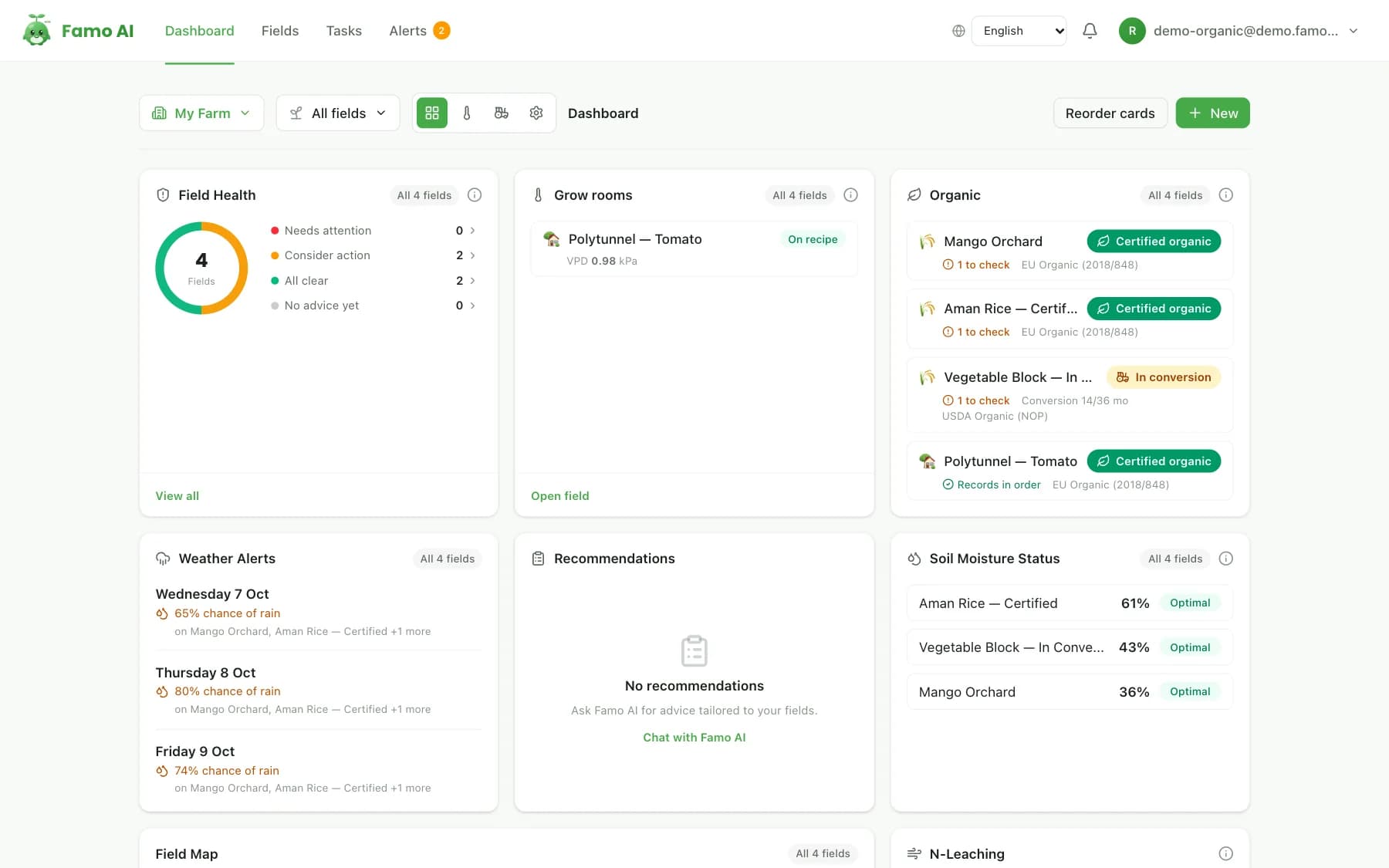
The live organic demo shows certified rice and mango, a vegetable block in conversion and a soil-grown tomato polytunnel, with a year of records — no sign-up needed. To plan your own conversion, build your organic package or talk to our team. For the wider platform, read what Famo AI is.